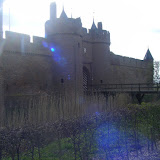
Our travels this weekend took us to Kasteel Doornenburg. What a beautiful castle! Of course, it was my first “real” castle, so I don’t guess I have much of a standard of comparison. Nonetheless, it was beautiful.
After our unintended excursion into Germany, we were glad to finally see something we’d planned. The road to the castle was an experience. For several kilometers we drove along a one laned road atop a levy. When meeting oncoming traffic, each of us scooted as far as we could to the right without toppling over the edge. The pictures just don’t do it justice. I think I saw this in a James Bond movie once. As we neared the castle, the road went to strictly one lane without even room to “skooch” over. If we’d met someone on this road, one or the other of us would have had to back up.
I’ve put all of our pictures out here for you all to see. There are a bunch, considering both Rick and I were snapping as fast as we could, and some repetition. The first few are of the drive to the castle, then those of the castle. As you can see, we were there on an overcast winter day. I’ve also included a few pictures that I found on the internet of the castle in the summer with all of the lush greenery. Maybe we can go back!
A Little History of the Doornenburg Castle
Doornenburg Castle dates back to 1295; however, the oldest parts of the present structure date back to the 14th century. In the 15th century the courtyard was gradually built over and various parts were continually heightened which, finally in the 16th century, gave the castle its present block shaped appearance.
The formidable walled bailey (the outer wall of a castle and the area within these walls) in its present form dates back to the 15th century. The chapel is probably a 16th century addition while the domestic buildings and the farm on the bailey date back to the 17th/18th century.
There's really not much to tell about the history of the castle up until 1936. It was never besieged, it didn't play any role in the political history of the Netherlands and no one of fame ever resided in it.
In 1936 the castle was bought, in dilapidated shape, by a local industrialist JH. van Heek, who handed it over to his "Foundation for preservation of the Doornenburg." A large restoration followed which was completed in 1941. This was obviously bad timing as the castle came to be in the frontline in 1944 following the failed Battle of Arnhem. The castle then became a German headquarter which caused the castle to be destroyed by British bombers on March 14, 1945. The fleeing Germans then blew up the gate building. Although rebuilding the castle seemed a lost cause, the foundation again started to rebuild the castle in its late-medieval style and by 1966 Doornenburg Castle had risen again.
Doornenburg Castle is a nice castle to visit although you have to keep in mind that the present structure is predominantly the result of the 20th century rebuilding following WW 2. The walled bailey is unique in the Netherlands.
 |
| Kasteel Doornenbur |


 Posts


0 comments:
Post a Comment