Everyone has heard of Stonehenge in England, but who knows of even older and more numerous Holland megalithes. A megalith is a large stone (from the ancient Greek megas meaning great, and lithos meaning stone). These structures were constructed as monuments or aboveground burial chambers, of large stones and covered with earth or other, smaller stones without the use of mortar or cement.
Even most of the Dutch themselves are unaware of the richness of the prehistoric monuments in their own country. But they exist and are said to have been there for over 5000 years–even older than the Egyptian pyramids! Built of huge granite stones, some of them weighing over twenty tons, dragged to the spot and piled up to form a rectangular stonegrave..
There are still 54 of them. Fifty-two in the province of Drenthe which is just north of Hengelo a little over an hour away. "Hunebedden" as they are called here, were not built by Hunen (giants) nor are they beds, but graves..
In Drenthe there are no mountains or rocks, but the hunebedden are made of huge stones which were "imported" from Scandinavia. About 200,000 years ago if you believe the secular theory of things, during an ice-period, Holland and most of northern Europe was covered by a thick layer of ice. The big boulders of which the hunebedden are made of were transported to Holland by slow moving ice-glaciers..
About 4000 BC (let’s see, that would have been about the time of the flood), hunters that visited Drenthe learned to grow wheat, to domesticate cattle, and to build farmhouses. They settled here as the first farmers in the region. Archaeologists call this period the Neolithics or New Stone Age. These farmers cut the woods with stone axes and cultivated the arable land. About 3450 BC they started building huge stonegraves using the big boulders that were scattered all over the place. They also made all sorts of earthenware, many of them in the form of a funnel. Because of that archaeologists say this people belong to The Funnel Beaker Culture.
.
One might ask, why these simple farmers made such a tremendous effort to drag those heavy boulders to a construction site and pile them up to making a huge stonegrave and how on earth did they do this?.
Dolmen, like those we saw, are the most common type of megalithic construction in Europe. They are a chamber consisting of upright stones (orthostats) with one or more large flat capstones forming a roof. Many of these, though by no means all, contain human remains, but it has been debated as to whether or not use as burial sites was their primary function–again, different schools of thought..
These megalithic structures also known as dolmen are a type of single-chamber burial tomb, usually consisting of three or more upright stones (megaliths) supporting a large flat horizontal capstone (table). It is assumed that most dolmens were originally covered by earth or smaller stones to form a barrow, though today in many cases that covering has weathered away, leaving only the stone "skeleton" of the burial mound intact..
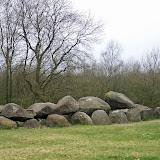
Now that you know what you’re looking at, take a look at the hunebedden Rick and I visited. These rocks are huge and you can’t imagine how they could be moved without modern machinery...of course, I guess this was practice for the pyramids.
.
Most of the hunebedden are scattered throughout this rural district. There is one place (at the largest one) where there are lots of tourist and its impossible to get a decent picture; however, we enjoyed the chance to get out and explore some of the more remote spots..
It was a good day to explore the local sights and countryside. Hope you enjoy our pictures!.
As we were preparing to head home, we tried to stop at Robinhood’s Inn for lunch, but it was closed. We found a quaint little bistro somewhere...would love to remember where it was! Lunch was great!



 Posts

